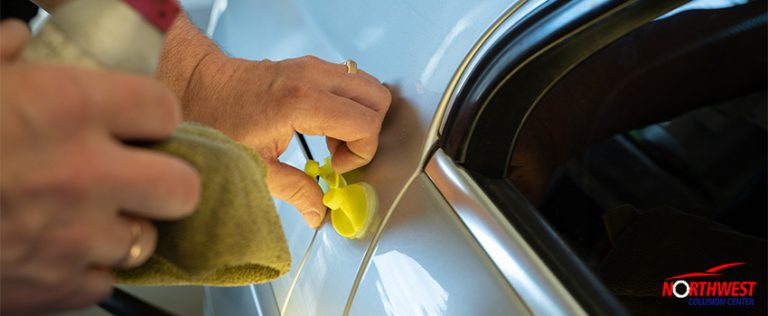
When your car has dents or dings due to a collision or an accident, bring it for a paintless dent repair service immediately.
No dent is too small when it comes to your vehicle. Dents affect not just the appearance of your car but also its performance. It’s important to address any damage to your car — for your safety and those in the streets.
When you type in “paintless dent repair near me”, you’ll see multiple auto body shops around your location. Now, how do you who’s trusted? Northwest Collision Center has a one-stop guide for you. Find out what it is, how much it costs, and how to choose.
What Is Paintless Dent Repair?
Paintless Dent Repair (PDR) is an environmentally-friendly process of restoration. What happens here is that your automobile’s body is restored to its former condition without painting. PDR is a recommended repair method for minimal damages.
Among the damages PDR can fix are:
- dents;
- dings;
- hail damage; and
- body creases.
Compared to the traditional method of repairing dents, PDR is more affordable, quick, and efficient. You’ll be back on the road in no time.
What Happens During Paintless Dent Repair?
Skilled technicians perform paintless dent repair services. They use meticulous techniques and tools to fix the damage with precision and accuracy. During the process, experts restore the car into its factory-like condition without damaging the paintwork and putting a hole in your pocket.
Aside from knowing the answer to, “what is paintless dent repair?”, find out how experts make the magic happen. Here’s how they do it:
1. They Assess the Damage First.
Before they bring out their tools, they assess how big the dent is, where it is located, and how they will approach it. They’ll also determine whether PDR is the best method of repair. Once they know the situation, they’ll prepare the area around the dent.
2. They Find Access to the Dent.
To successfully perform PDR, experts find a clear entry point to the dent. In most situations, they have to access the dent from the back. They may have to remove the taillights, body panels, and interior panels. Once there’s unobstructed access to the damage, we’ll bring out the tools to do the repair.
3. They Take a Better Look at the Damage.
Using a special light board, expert mechanics will take a better look at the dent from his/her perspective. The light board allows the technician to approach the dent precisely and accurately.
4. They Apply the Right Amount of Pressure to Repair the Dent.
Skilled mechanics will then use the tools to massage the dent back to its original position.
Paintless dent repair services restore your car’s frame as if no damage has been done. To know whether the dent on your car is repairable through PDR, bring it to your trusted auto body shop.
How Much Does Paintless Dent Repair Cost?
As previously mentioned, PDR is cheaper than the traditional dent repair method. The process is fast and it doesn’t involve painting or curing. Now, “how much does paintless dent repair cost?”
Every auto body shop has its own pricing. The rates will depend on how extensive the dent is and if there are any repairs needed to be done. Here’s a ballpark figure of paintless dent removal:
- Small dings: Around $75 to $125
- Larger dents: Around $150 to $450
Ask a mechanic for a quotation to know how much you’ll spend to fix the dent on your car.
What Are the Benefits of Paintless Dent Repair?
Many car owners are choosing PDR for many good reasons. Here are some of the benefits of paintless dent repair services:
1. PDR Maintains the Value of Your Car.
Any damage to your car affects its resale value. With paintless dent repair, the damage is taken care of without compromising your car’s worth. This is also a suitable repair method for antique cars where paint color matching is more complicated.
2. PDR Caters to Minor and Major Car Dents.
You can bring your car to an auto body shop near you for PDR. PDR works on small dents, shallow and larger dents, even small dings. If the collision damaged your car’s paintwork, they will recommend getting a paint job to maintain your car’s aesthetic.
3. PDR Is Approved by Leading Car Manufacturers.
PDR is a widely-used restoration method in the automotive industry aside from the traditional body shop work. Leading car manufacturers approve paintless dent repair as a repair technique.
How to Choose a PDR Provider?
When it comes to PDR services, it’s essential that you only go to the trusted experts in the field. Here are some tips to consider as you search for “paintless dent repair near me:”
1. Read Online Reviews.
When looking for paintless dent repair services, take the time to scroll through the reviews of the previous clients. From there, you’ll get an idea of how a shop works. You can also compare their ratings on Google and narrow down your options.
2. Consider the Years of Experience.
If you’re left with two choices: a seasoned or a newly-established auto body repair shop, which would you choose? That’s right! The one with years of experience in the field. It’s a testimony of the quality of their work. Have confidence knowing you’re leaving your car to the experts.
3. Look at Their Customer Service.
When choosing an auto body shop, consider their after-sales service. You want professionals who make you and your beloved car feel valued. Their customer service — from beginning to end — speaks volumes on how much they value you as their client.
4. Confirm Their Certifications and Insurance.
A seasoned auto body repair shop has the certifications to prove that its work is up to the highest standard. When it comes to your car, make sure that the people working on it are certified and insured. Certifications and insurance offer peace of mind knowing your car is in good hands.
5. Don’t Forget to Compare Their Rates.
As a customer, comparing the rates of one’s shop to another is a smart move. The prices will vary depending on the size of the dent. Asking for estimates in two or three auto body shops will give you an idea of how much you need to spare for the repair. Don’t get too excited about prices on the low-end bracket as the final result may not be what you’re looking for.
6. Look at the Services They Offer.
Ideally, you want a repair shop that caters to a variety of car problems. With car dents, there may be other problems resulting from the collision or accident that needs to be addressed. You want an auto repair shop that performs all the services your car needs.
Get the Care Your Car Deserves at NCC!
Northwest Collision Center is one of the trusted auto body repair shops in St. Petersburg, FL.
Get top-notch paintless dent repair services from our seasoned mechanics. We are I-Car Gold certified repair facility — the one and only auto repair shop with this certification in St. Petersburg, Florida. NCC’s owner also has certifications from:
- Chief Collision Systems
- ASE
- CCC Pathways Estimating Program
- Sickens & PPG Auto Refinishing
- I-Car Platinum
Let us be in the know when you need PDR services. Call us!