Back in the seventies, many Americans were dedicated to speed and large, powerful engines manufactured in America. This was American speed and mechanical muscle, representing how America was leading the free world. Referring to his car, the lead singer of Deep Purple sang, “I love it, and I need it, I bleed it,” and those lyrics summarized how many Americans feel about their cars.
American manufacturing kicked into gear, and the American automotive industry was spearheading it all. The growth in the American car industry encouraged rapid growth in related industries such as car body repair and services. The growth in the car repair and services industry is demonstrated by its projected global annual revenue of over 115 billion USD globally.
The numbers don’t lie.
Common business parlance states that numbers don’t lie, so with that in mind, let’s look at some stats for the auto bodywork maintenance and repair sector. Analysts estimate that by 2026 the global car bodywork maintenance and repair industry will generate 678 billion USD, and in 2022 in America, the industry will generate more than 9.6 billion USD.
The US Bureau of Labor Statistics divides the car body repair industry into three separate segments, including:
- Segment 1 – Automotive Body Paint Interior and Glass Repair
- Segment 2 – Automotive Mechanical and Electrical Repair and Maintenance
- Segment 3 – Other Automotive Repair and Maintenance
The total revenue generated within categories 1 and 2 is estimated to surpass $64.2 billion by 2024.
Types of Maintenance and Bodywork Repair
There are many different types of car maintenance and bodywork repair, but they all have the same objective – to ensure your safety and the functionality of your car. Here are some maintenance jobs and repair procedures typically performed by a professional car body repair shop:
Dent Repair
A car’s bodywork is primarily composed of sheet metal. Car manufacturers use sheet metal because it is robust ( has an impressive strength-to-weight ratio), can absorb the impact force, and is rust resistant. Perhaps the most common type of auto repair is the removal of dents.
However, there is always a downside, and in the case of thin steel sheets, the downside is that they dent comparatively easily, which explains why dent repair is the most frequently needed repair work.
Typically, professional car collision repair centers will categorize a dent as one of the following:
- Sharp Dents. A sharp dent is caused by the forceful impact of a sharp object. The sharp dent will have stretched metal and contain a raised section with a cavity. The sharp dent is commonly caused by other car doors being opened and hitting yours.
- Creased Dents. A creased dent results from a foreign object striking your car and then being dragged along the car’s surface. For example, a creased dent may occur when a moving car impacts a low-hanging tree branch, and the branch is dragged along the car’s exterior surface.
- Round Dents. As the name implies, this type of dent is defined by its circular shape. Round dents usually happen when you park near a ball or a kids’ park. The dents are caused by a round object like a soccer ball or basketball impacting your car.
- Extreme Dents. Extreme dents are the largest type of dent, and they are caused by impact between a large object and your car. For example, an extreme dent will occur when someone falls on your car or when you collide with an animal.
A professional car body repair technician will typically repair a dent using either the paintless dent repair approach or the auto body filler and paint-over technique.
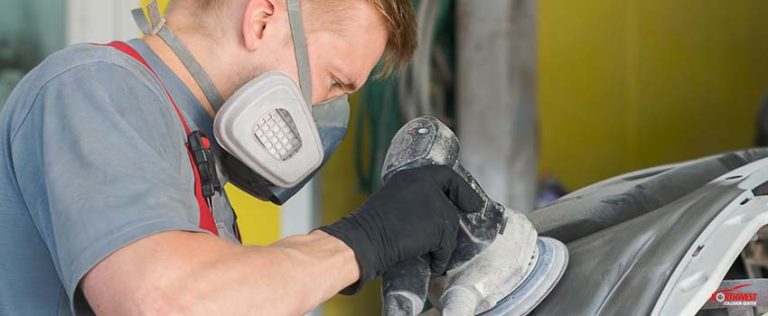
The body filler technique involves panel-beating the dent as much as possible, filling it with a body filler, sanding it down until completely smooth, then spraying it over it with paint.
The paintless dent repair process involves gluing suction tabs onto the dent and using a special puller tool to draw the dent out. This is a gentler and smoother process and does not require spot painting.
Panel Beating
In today’s world of advanced repair techniques, paintless dent removal is the go-to procedure. However, even paintless dent removal will involve some panel beating in the initial stages, and the reality is that in the auto body repair world, panel beating is the foundation for all procedures.
It is worth noting that panel beating may seem easy, but it is always a good idea to let qualified and experienced personnel do the job for you for professional results. A professional panel beater will have the necessary training, experience, and car body repair tools to produce the best results in the quickest time.
Car Body Repair Kit
While it is always recommended to let a qualified tradesperson repair your car, there are times when this is not an option, and you will have to engage in DIY repairs. If attempting Do-It-Yourself car body repairs, you will need a special car body repair kit.
A typical car body repair kit will include specialty tools and spare parts that help you do the repair job. Typically, this will include everything from a socket set, a set of screwdrivers, a torque wrench, and an impact wrench to a rubber mallet, wire cutters, metal patches, body filler, and a pulling device for paintless dent removal.
How Much Does a Car Body Repair Cost
As with any other professional service, car body repair costs money, and how much you pay depends on various factors. For example, the cost can be influenced by what sort of car you drive, what part of the car needs repairing, what type of damage has occurred, whether they will have to use special computerized equipment and the repair shop’s location.
On average, you can expect to pay anywhere from $100 for basic repairs to $10,000 for frame repair of high-end vehicles. Typically, repairing the front or rear end will range from $200 to $2,000, and a front or back bumper repair job will range from $100 to $1,500.
Conclusion
As the automotive industry has grown exponentially, so have associated industries like car body repair. The auto body maintenance and repair sector in America currently generates approximately $9.6 billion, and globally, the industry is expected to produce more than $678 billion.
The automotive maintenance and repair industry is expected to experience considerable growth, even with the current emphasis on electric cars. No matter if your car is electric or gas powered, it still has a body made from thin steel sheets, and when involved in a collision, the body becomes damaged and needs professional repair work.
For car body repairs, look no further than Northwest Collision Center.
When your car is damaged and needs its bodywork repaired, it may be tempting to try to do the repairs yourself. However, this is highly advised against as what is initially conceived as a cost-saving exercise can actually end up costing you more.
Suppose you are involved in a collision or, for any reason, your car’s bodywork is damaged. In that case, it’s time to contact a professional repair center like Northwest Collision Center, the most trusted auto body shop in St. Petersburg, FL. The professional tradespeople working here are thoroughly trained in all the traditional and latest auto bodywork repair techniques and have the most modern equipment and tools. All of this adds up to a thoroughly professional auto body repair job. Call now to get a quote.